Computational Flow Physics


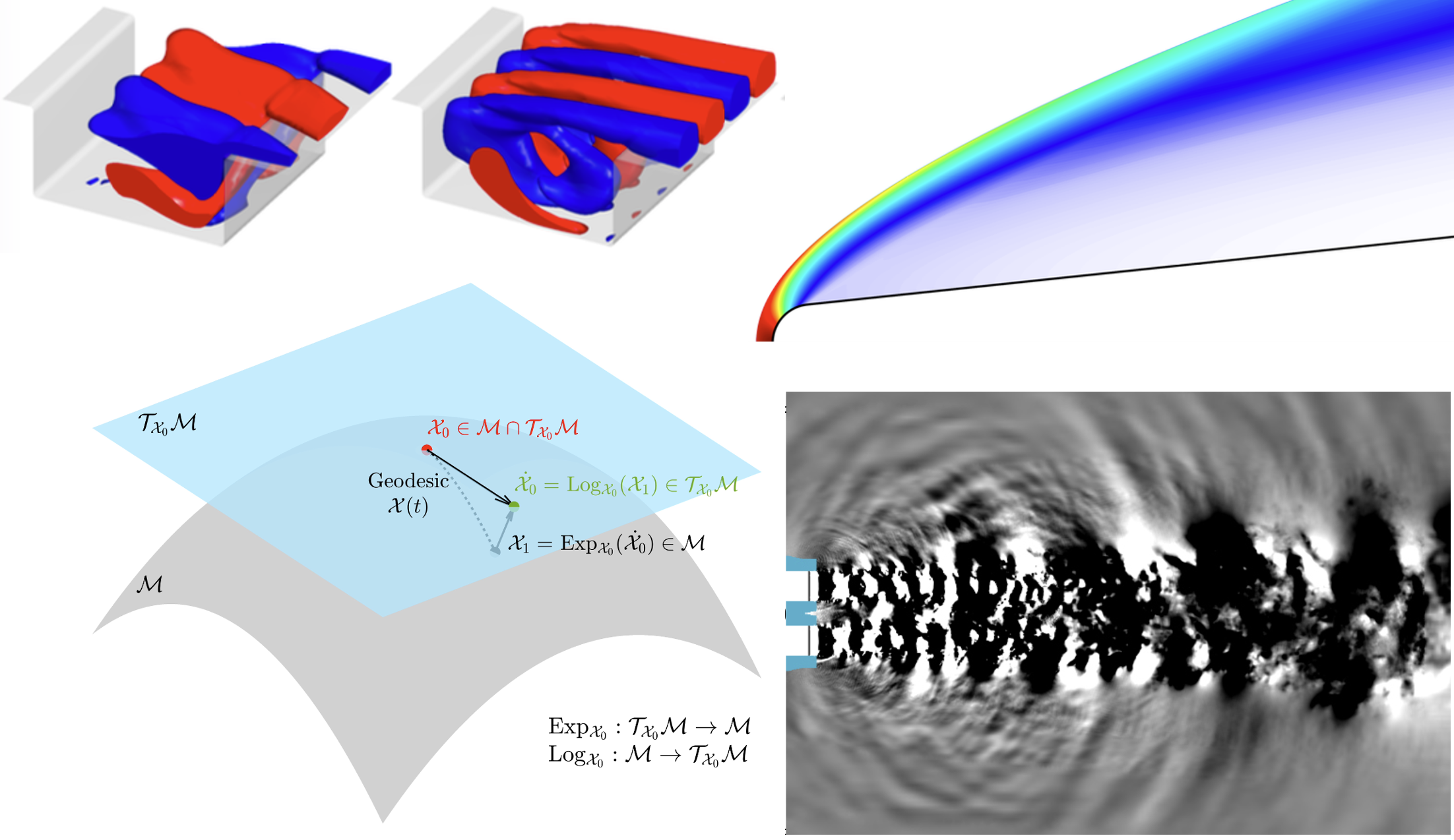
Welcome to the Computational Flow Physics Group at UC San Diego! We develop advanced numerical simulation and data-driven analysis tools to understand, model, and predict turbulent and multiphysics flows in engineering and nature. Our work combines high-fidelity computation with modal decomposition and feature extraction to reveal coherent flow structures and translate them into predictive reduced-order models for forecasting and optimization. We focus on aerospace problems, including jet noise control, unsteady aerodynamics and aeroacoustics, transition, dynamic stall, aero-optics, and hypersonics. While our work is grounded in physics-based modeling, we also curiously explore where modern machine learning can complement first-principles simulation, statistical methods, and classical closure techniques. Beyond aerospace, our methods extend to complex geophysical flows, with applications in atmospheric science and physical oceanography.
News
| Sep 15, 2026 |
New MS thesis opening on data-driven modeling of unsteady shock dynamics from schlieren imaging. Details and how to apply. 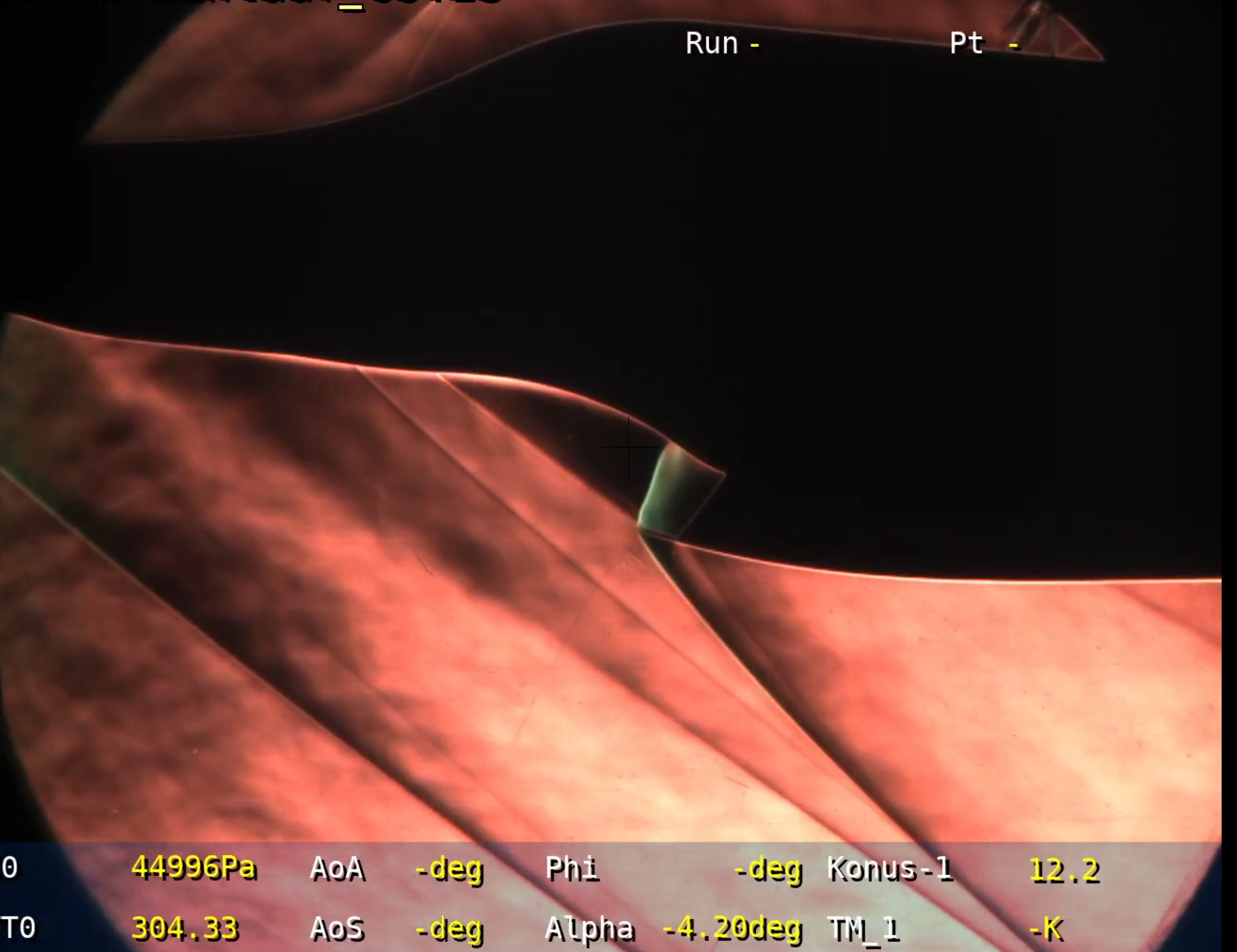 |
|---|---|
| Jul 15, 2026 |
Delighted to share our new JFM paper (Mazharmanesh et al., 2026) exploring how triadic interactions drive mean-flow deformation in screeching jets. Congratulations to Soudeh and the entire Monash team on this excellent work!
|
| Jun 23, 2026 |
Big congratulations to Brandon on our new Physical Review Fluids paper (Yeung & Schmidt, 2026) on space–time analysis of actuation transients in plasma-controlled jet flow. The study uses space–time modal analysis to isolate the transient response to actuation and separate it from the natural and forced dynamics of the jet.
|
| Jun 11, 2026 |
Huge congratulations to Brandon on receiving the 2026 MAE PhD Outstanding Student of the Year Award at today's End of Year Celebration!
So well deserved! |
| Apr 21, 2026 |
Big congratulations to Cong for the great work on our JFM paper (Lin & Schmidt, 2026) on boundary layer transition as a succession of temporal and spatial symmetry breaking.
|
| Apr 17, 2026 |
Excited to share our new Journal of Geophysical Research: Oceans paper (Papoutsellis et al., 2026) on obliquely incident nonlinear internal waves shoaling on a shallow shelf, combining distributed temperature sensing observations with idealized simulation.
|
| Mar 19, 2026 |
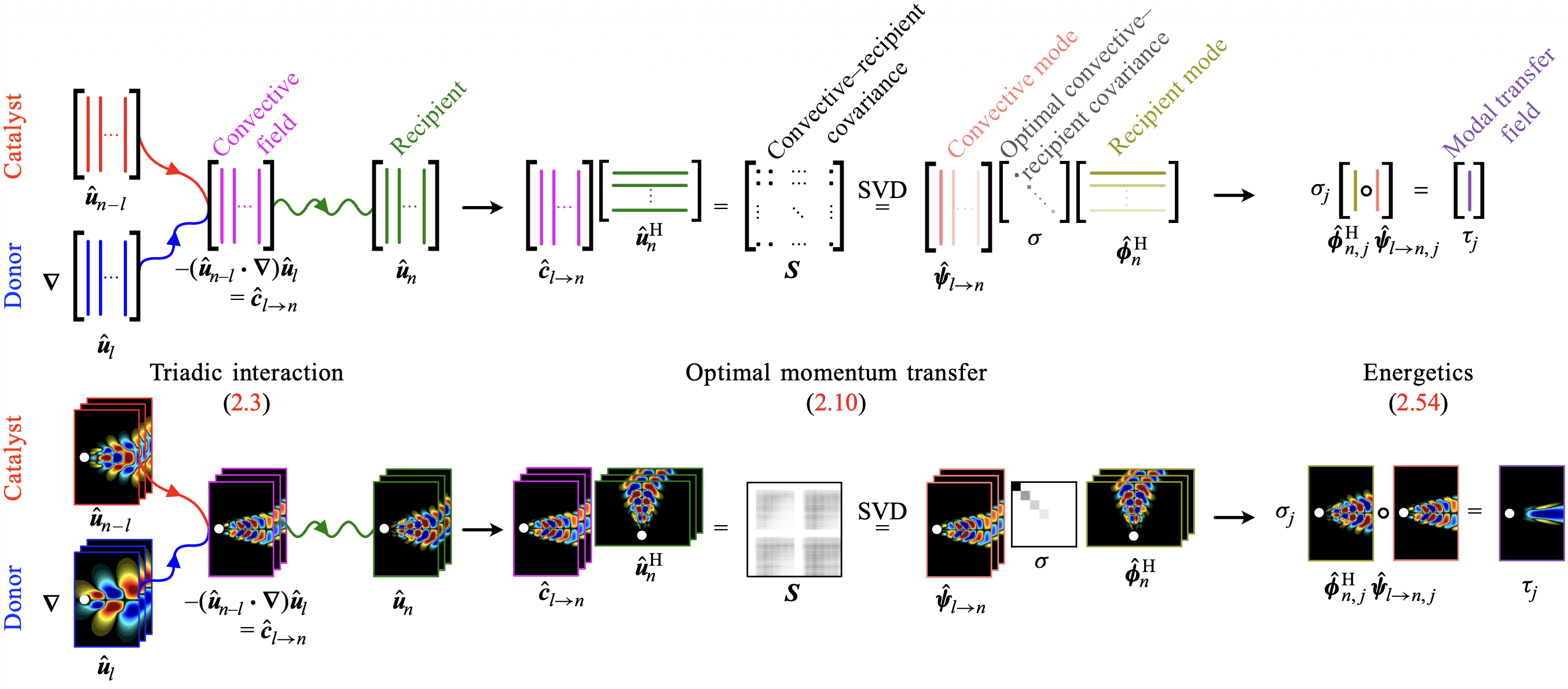
We are excited to share our new paper (Yeung et al., 2026), co-first authored by Brandon and Tianyi, introducing Triadic Orthogonal Decomposition (TOD), a new method for uncovering and quantifying nonlinear energy transfer across scales in fluid flows. Demonstrated on canonical and engineering flows, using both numerical and experimental data, as well as isotropic turbulence, TOD reveals coherent structures, coupling mechanisms, and the local regions responsible for interscale transfer. The illustration below outlines the algorithm.
|
| Jan 28, 2026 |
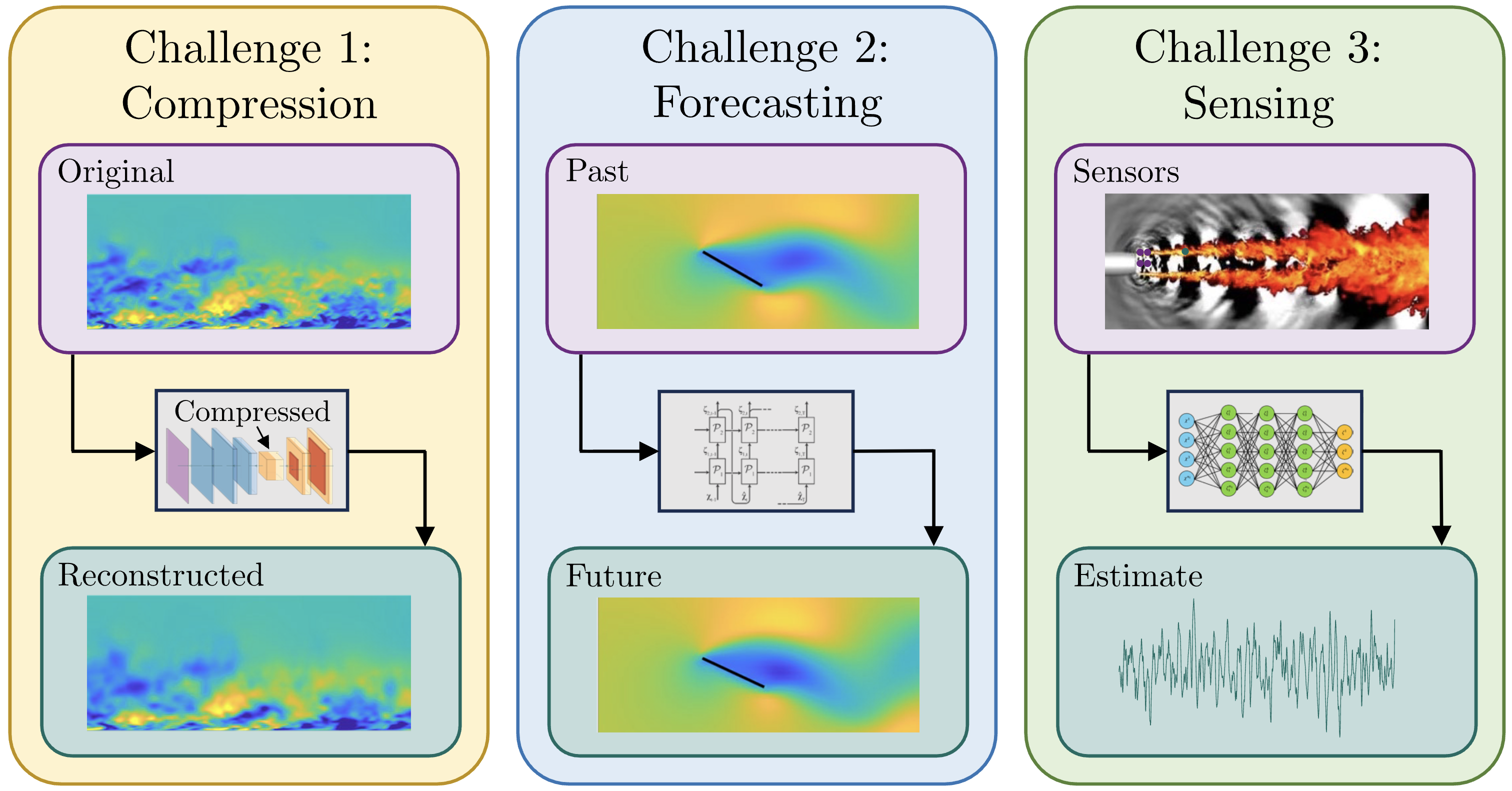
Excited to announce a new community challenge developed with Aaron Towne, Adrian Lozano-Durán, Scott Dawson, and Ricardo Vinuesa! We're targeting three core capabilities—compression, forecasting, and sensing—that address common needs in analysis, design, and control of complex fluid flows.
The challenge emphasizes data-driven approaches and enables fair, transparent comparisons through standardized datasets and success metrics. Participants are free to use any method, are expected to release their code, and will be evaluated via blinded testing on held-out data. Outcomes will be disseminated through papers in an AIAA Journal Virtual Collection and invited presentations at AIAA Aviation and SciTech special sessions. |
| Jan 16, 2026 |
Great showing by the group at AIAA SciTech in Orlando! Brandon presented his work on RL-based active control for supersonic jet noise (Yeung & Schmidt, 2026), Jaein introduced new scaling laws for hypersonic entropy layers (Lee et al., 2026), Eden talked about centrifugal-Rossiter interactions in cavity flows (Shokrgozar & others, 2026), and Yihong shared his Grassmannian manifold approach to SPOD mode interpolation (Zhu & others, 2026).
|
| Dec 19, 2025 |
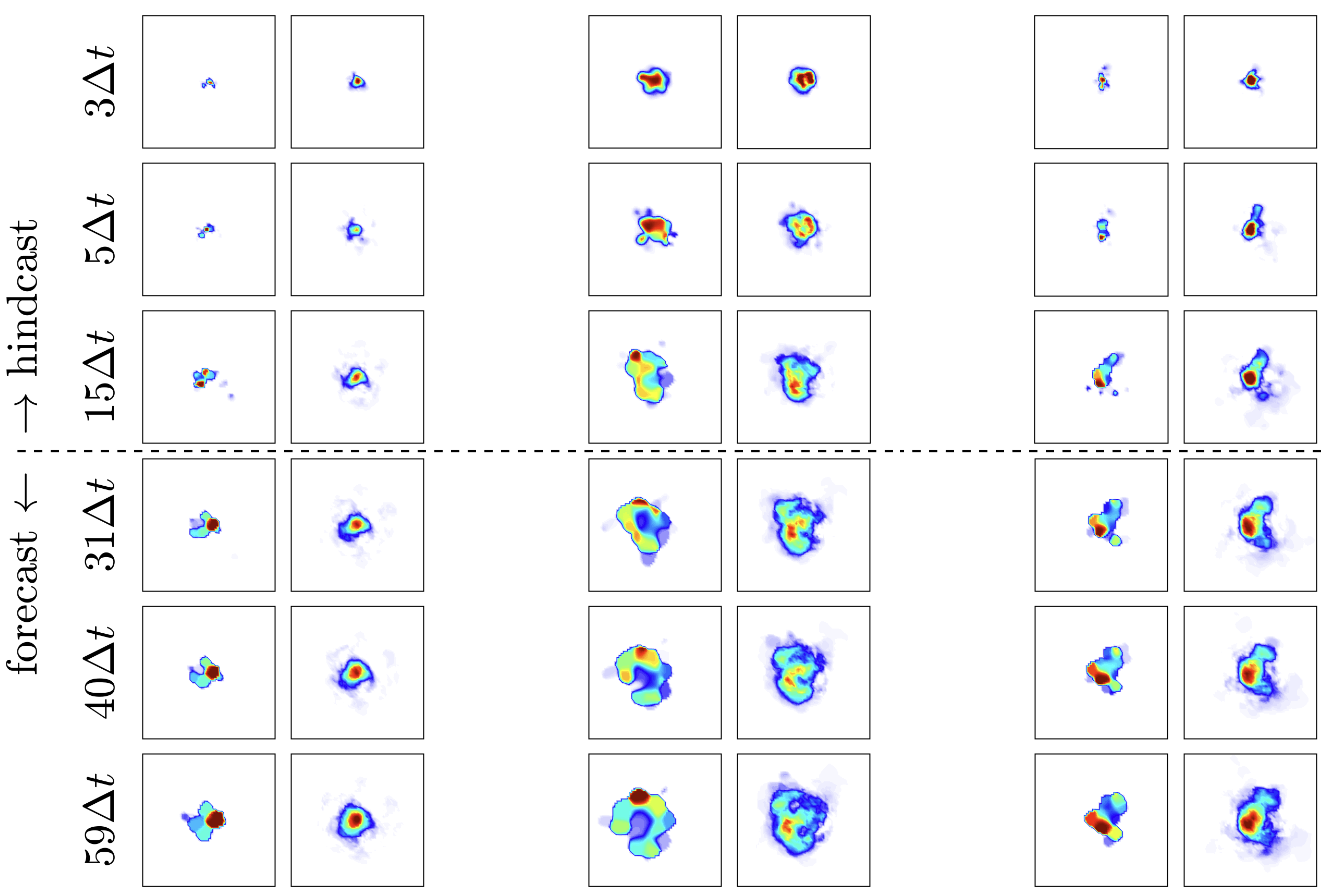
Forecasting how real-world flows evolve is notoriously challenging. Take a look at our new article (Schmidt, 2026) on Space–Time Projection for forecasting high-dimensional transient and stationary flows.
|


Recent Publications
Support & Acknowledgments
We are grateful for the support of the U.S. National Science Foundation, the U.S. Department of Energy, the U.S. Air Force Office of Scientific Research,the U.S. Office of Naval Research, the U.S. Army Research Office, and the NISEC and ACCORD centers. We sincerely thank the program officers and center leadership for their sustained commitment to fundamental research and its translation to impactful applications.