MS Thesis: Data-Driven Parametric Modeling of Unsteady Shock Dynamics from Schlieren Imaging
Data-driven reduced-order modeling of unsteady shock systems in time-resolved schlieren imagery of a supersonic aircraft inlet, combining shock detection, sparse/modal decomposition, and parametric surrogate modeling.
Master’s thesis project in compressible-flow analysis, reduced-order modeling, and scientific machine learning.
Introduction
Shock location and unsteadiness strongly affect the performance and stability of supersonic aircraft inlets. Time-resolved schlieren imaging reveals these phenomena in exceptional detail, but converting large image datasets into predictive models remains challenging. Compact, parameter-dependent models could enable rapid evaluation of new operating conditions and ultimately support inlet design, optimization, and flow control.
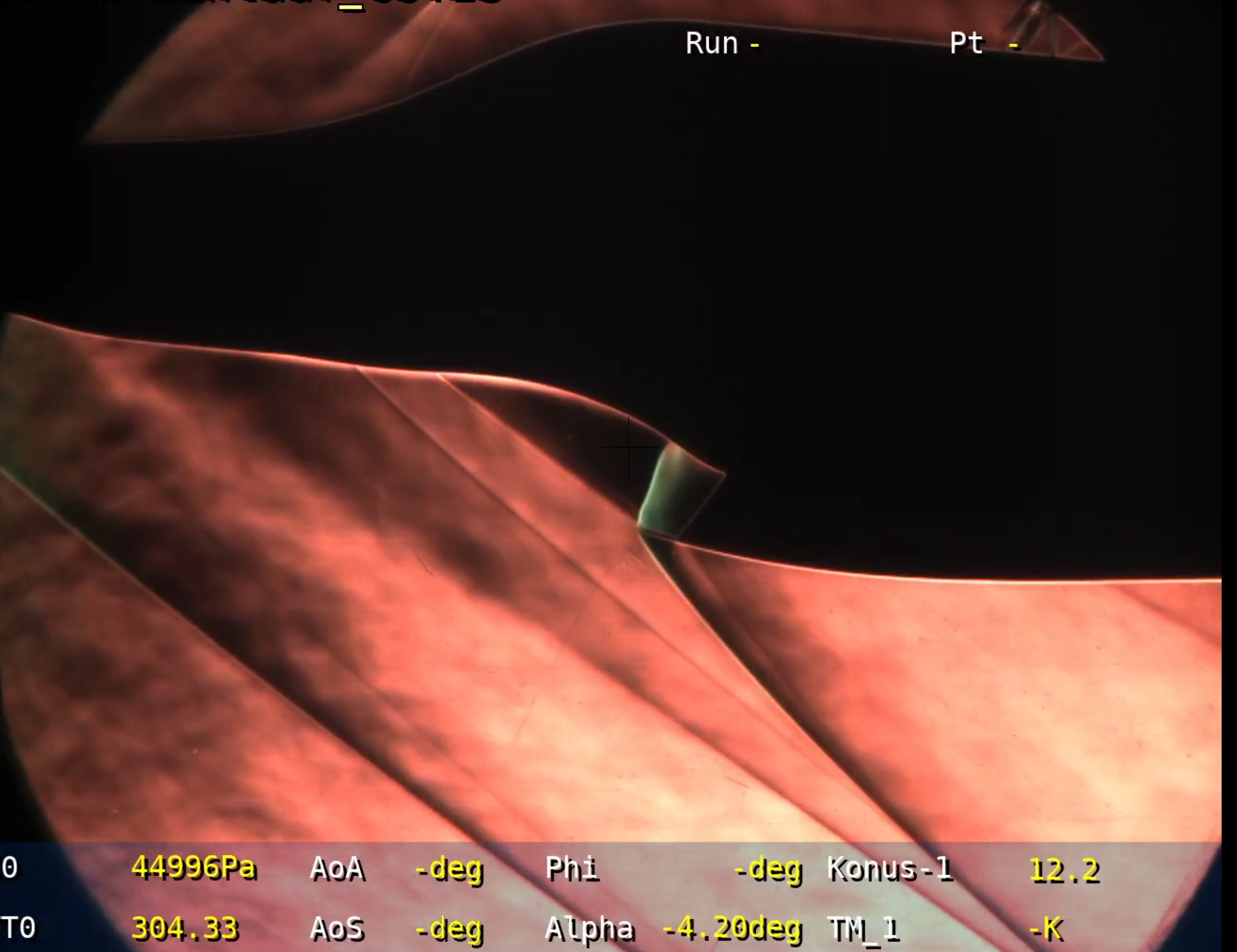
Time-resolved schlieren visualization of the unsteady shock system in a supersonic aircraft inlet, a representative frame from the experimental dataset that will form the primary basis of this thesis, spanning variations in freestream Mach number, angle of attack, and inlet mass flux. Image courtesy of DLR.
Project objective
This project will develop data-driven reduced-order models of unsteady shock systems observed in time-resolved schlieren images of a supersonic aircraft inlet. The available experimental data cover a range of operating parameters, including Mach number, angle of attack, and inlet mass flux.
The central objective is to predict shock geometry and unsteady shock behavior at operating conditions not included in the training data. Quantities of interest may include mean shock location, oscillation amplitude, dominant frequencies, and other statistical or spectral descriptors of the shock motion.
Research tasks
Depending on the student’s interests and background, the work may include:
- Developing and comparing methods for detecting and tracking shock fronts using classical image processing, computer vision, or scientific machine learning.
- Constructing compact representations of shock geometry and dynamics using modal and sparse-decomposition techniques. The student will have access to an in-house modified sparse-decomposition framework developed for the analysis of transient flow phenomena.
- Building parametric surrogate models, such as Gaussian-process regression or radial-basis-function models, to predict shock behavior across the operating-parameter space.
- Evaluating predictive accuracy at withheld operating conditions and investigating the limits of interpolation and extrapolation.
The project will initially be entirely data-driven and will use existing experimental measurements; conducting new flow simulations is not required. Simulated data may be incorporated for training augmentation or validation if useful.
An optional extension is to investigate whether detected shock geometry, together with oblique-shock relations and suitable physical assumptions, can be used for regional Mach-number inference.
Research environment
The project combines compressible-flow physics with modern methods in reduced-order modeling, signal processing, computer vision, and scientific machine learning. The student will work within the Computational Flow Physics Group at UC San Diego, specializing in spectral and statistical methods for transient flow phenomena, and will benefit from collaboration with the researchers providing the experimental data.
Candidate profile
Applicants should have:
- A strong foundation in compressible flow, including relevant coursework.
- Experience with numerical methods and scientific programming.
- An interest in combining physical modeling with data-driven analysis.
Experience with numerical linear algebra, signal processing, computer vision, reduced-order modeling, or scientific machine learning is desirable but not required in every area.
Eligibility and supervision
The project is open to UC San Diego thesis-track master’s students. Remote participation may be possible if a suitable local co-supervisor and supervision arrangement can be established.
Contact and application
Faculty supervisor: Prof. Oliver Schmidt, Mechanical and Aerospace Engineering, UC San Diego
To apply, please email a CV, an unofficial transcript, and a brief statement describing your interest in the project and highlighting relevant coursework or project experience. Links to relevant code, reports, publications, or other work samples are welcome but optional.
Please use the subject line “MS Thesis Application, Schlieren Modeling.”